Thursday, March 21, 2013

The Wonder of Boys: Part One


The Wonder of Boys: Part 1
My next boy book is The Wonder of Boys: What Parents, mentors, and Educators Can do to Shape Boys into Exceptional Men by Michael Gurian.  

Guiran begins his book explaining similar notions of Raising Cain.  Boys are in pain: emotionally.  Boys are suffering because society is not raising boys to be the best men; instead, society fails our boys time and again.  Through divorce, bad parenting, media, mothers who won’t let go and fathers who are absent, boys grow up disadvantaged and angry.  

I was surprised by Guiran’s exploration of brain differences in males and females. Males have larger brains focusing on spatial relationships and activity but females corpus callosum allows for females to be better at reading and interpreting emotions. Boys are better at focusing on single issues rather than multiple issues. I can easily identify with this in my all boys’ class.  Getting the gentlemen to do more than one task at a time is almost impossible without proper structure and scaffolding of the tasks.

Guiran expands on these issues of male and female differences later on by explaining the importance of females in young boys lives.  In their early years, mothers hold a special connection to their sons, creating and fostering the emotions of boys. Single mothers, of course, struggle more with this as a result of time and lack of support. However, once boys reach puberty, boys need to be “let go” by their mothers and guided by their fathers.  Some women really struggle with letting go which can be detrimental to the future growth of the boys.  The goal of both parents should be “we can teach him how to develop who he is with confidence, and towards a direction that contributes to our world. In this view, our best choices in nurturing him revolve around knowing who and what he is, then channeling his energy in ways appropriate to him” (Guiran 5).  Interestingly enough, “the single most important influence on our boys is how they see their parents be intimate” (Guiran 20).

Connecting Guiran’s opening remarks about boys to my own class, I can see the importance of creating relationships with my students.  Boys need to feel valued in order to work hard for someone. They also need purpose behind what they are doing, or are asked to do in order to allow them to see where they are going. Boys need to be involved in the activity: make it a game, a competition, a goal, where they are to move around. Boys need to have a learning environment that allows for them to be open and honest with their emotions. That helps them develop a language to express those emotions.  How do boys experience feelings and emotions:

  • Action released method: quick bursts of emotion
  • Suppression delayed reaction method: solve problem then emotionally react
  • Displacement objectification method: project emotions on other objects
  • Physical expression method: space and objects to properly deal with emotions
  • Going into the cave method: boys need time and space to process emotions
  • Problem solving method:solving the problem releases emotive energy
  • Crying method: boys only cry under very stressful and safe circumstances

Guiran identifies 7 principles that boys’ culture is based upon.

1. Competition: boys’ need healthy competition. Competition helps boys learn skills and feel success: two attributes that if boys don’t feel, they will feel “lost.”  Competition “is a form of nurturing behavior”.  This is why it is important for boys to participate in organized sports.  The competition must be appropriate for the boy by contributing to his positive self esteem and build his confidence.
2. Empathy: boys struggle with empathy. To teach a boy to be empathetic, Guiran encourages the modeling of empathy or making empathy part of the task in order for boys to grow.
3. Large group: boys prefer groups rather than 2s or 3s.  The more people who recognize and see the success of the boy, the more “empowered” the boy feels.
4. Independence: boys even in groups can still maintain their independence.  Many single mothers struggle in this area and many families need mentors to assist in fostering independence, “without nurturing by acceptance, discipline, role-teaching, , natural and acculturated tendency toward independent activity, and personal freedom within group functions, we will raise boys for whom independence becomes not soulful solitude but tragic loneliness, and freedom becomes irresponsibility” (Guiran 41).
5. Personal sacrifice: boys need to understand the power they have and that that same power must be connected with others and doing best by and for others.  We need to find a way to harness boys’ passion and purpose and direct it in a purposeful direction.
6. Male role models: elder males teach boys how to treat females; how to develop boundaries with females, how to deal with changes to their bodies, minds and souls.
7. Making sport of life and life of sport: boys need structure, skill and focus to deal with their aggressiveness.

Thursday, March 07, 2013

Raising Cain

Raising Cain: Part 1
I started reading Raising Cain as the first book for my all boy series of literature.  Kindlon and Thompson argue throughout the book that boys today are not taught an emotional language in order to express their feelings accurately.  We mold boys to fit our traditional model of men: tough, emotionless, strong, and brave.  however, boys often encounter “a culture of cruelty” where they are harassed, demeaned, receive conflicting messages about their emotions, and have unbelievable pressure cast upon them from society to withstand it all.

So, what do we do about it? How do we help our boys become men that are caring, concerned, empathetic individuals?  Kindlon and Thompson use a variety of stories to showcase the work they have done with a multitude of boys ranging from abuse victims, kids that suffer from depression, anxiety, anger, etc... They even work with parents to help them navigate through the adolescent years in order to give space and a voice to their emerging young man.

Thompson and Kindlon divide up the book into sections dealing with discipline, culture definitions of boys, relationships between boys and their moms and dads, depression, drinking and drugs, anger, relationships with girls, and finally ending with a chapter discussing what boys really need. As I was reading the book, the thoughts in my head centered around my all boys class as well as my relationship with my own boys.  How can I be a better teacher, mentor and leader for these young men? How can I help to shape them into better versions of themselves so that they are empathetic, ethically responsible contributors to the world? How can I help them express their emotions in a way that is productive for them in the long run? How can I help them develop an emotional vocabulary that enables them to get through the tough times in life?

My take-aways helped me to answer some of these questions, but not with a clear concrete plan.  I appreciate the authors attempts at giving the reader tools to deal with angry boys and how to help boys develop a language to deal with the anger.  Thompson and Kindlon write, “ Our challenge as parents and teachers is to teach the lessons of emotional literacy that enable a boy to bend under emotional trials without breaking into a violent revenge:

  • Life isn’t fair. learn to deal with it
  • You can’t go around hurting people every time you get angry.
  • You need to consider how your actions affect others.
  • Don’t see threats where they don’t exist.
  • You need to know that controlling your anger does not make you a sissy” (Kindlon and Thompson 222).

I didn’t think these lessons need only to apply to girls as well. The authors, on multiple occasions, create the argument that we enable girls to have an emotional language to deal with their lives, but yet we hold boys to a much different standard, making it uncool, or sissy like to express emotions. This was totally my life growing up. I can count on one hand the number of times I have seen my father cry: after his father passed away, and when he talked to my brothers and I about what happened to him in Vietnam; he’s a Silver Star recipient if that gives you an idea.  I see this in my own life letting my daughter cry about issues that are heartfelt to her, but yet talking to my boys about toughening up when they are crying about not wanting to do something. I am not giving them the emotional language to know how to deal with their sadness or disappointment by shutting down their emotions. I think about this as a teacher as well and how many times I have had boys cry in my office or in my classroom about failures they have experienced. I have always been so shocked to see their upfront display of emotion.  But yet felt honored that they felt safe enough with me to be honest with how they were feeling.

Thompson and Kindlon leave us with seven tips: (italicized their words, normal my 2 cents)
  1. Give boys permission to have an internal life, approval for the full range and human emotions, and help in developing an emotional vocabulary so that they may better understand themselves and communicate more effectively with others.
    1. When kids see their parents, role models, teachers express emotion in authentic and meaningful ways, they know it is safe for them to do so as well. They learn from our examples- both men and women, dads and moms
  2. Recognize and accept the high activity level of boys and give them safe boy places to express it.
    1. Get those boys outside.  Boys have energy and need productive ways to manage their energy.
  3. Talk to boys in their language- in  a way that honors their pride and their masculinity. Be direct with them; use them as consultants and problem solvers.
    1. Boys need to be involved in solving their problems. Give them choices with adults leading the way.
    2. If you listen to boys, they will listen to you.
    3. I’m still working on this one :)
  4. Teach boys that emotional courage is courage and that courage and empathy are the sources of real strength in life.
    1. Boys need to learn about real heroes not just ones in TV, in books, or in movies.  Set up real examples of courage and emotional vulnerability for them. Show them fear is ok.
    2. Show boys how to be empathetic.  Give them opportunities to care for others.
  5. Use discipline to build character and conscience, not enemies.
    1. Boys need direct and consistent discipline.  Focus on building off of love.
  6. Model a manhood of emotional attachment.
    1. Boys replicate the examples they see
    2. boys struggle with real friendships; help foster long lasting relationships
    3. Boys need times with just their dads and with men that are good role models
  7. Teach boys that there are many ways to be a man.
    1. Enough said.

And so, Thompson and Kindlon leave us with the lasting thought:

Our boys are going to grow up to be many sizes, to possess many skills and to do a wide variety of things. We must not disregard their many offerings; we must not make them feel they do not measure up, that we disdain their contributions. We have to ask a lot of them, morally and spiritually, and we have to support them in their efforts to please us. And if they try to please us, we must communicate to them that they are not a disappointment to us. The only thing that will make growing up psychologically safe for our sons is for them to know that we value them and that we love them, and that we have every confidence that they will grow naturally into good men” (Kindlon and Thompson 257-8).

I need to make my boys, both at home, in my extended family and in my classroom, know they are worth it. They are valued people in my life, blessings to all around them.

Wednesday, March 06, 2013

Going back to school

I have been remiss in my blogging. I admit it. I can’t seem to find the time nor place to think about teaching. To take the time to reflect on what I am doing. It seems mostly as though I have not given myself permission to take a break. I really miss thinking about learning.

So, a few of weeks ago, I started looking into taking graduate school classes to do two things: one, give myself the permission and time to learn; and two, give myself a pay hike since for the next six years I won’t go anywhere on our pay scale. I found a program where I can design my curriculum with the help of another teacher. Luckily, I found a teacher who is a former Language Arts teacher and someone who teaches using technology. I am combining two aspects into my study: single gender education with boys and technology. 

Why? Well, for one, I am a sister of three brothers. I grew up in a male dominated household. I always had more boys that were friends than girls. I have two sons now, who dominate much of our household. Also, I have a husband, there’s another male. A dad- more male. Then, to top it all off, I teach a single gender class- ninth grade all boys. What would be more fitting than for me to study about being a better teacher, learner, parent, leader, coach and mentor, than for me to study about males.

 I am going to read a number of different books about boys. My former principal bought these books for me when I first started teaching single gender classes and I have not had the time to read them. Maybe the timing wasn’t right, but it is fitting in perfectly now. The books are the following:
 • Raising Cain: Protecting the Emotional Life of Boys –Dan Kindlon, Ph.D and Michael Thompson, Ph.D
 • The Wonder of Boys: What Parents, Mentors and Educators Can do to Shape Boys into Exceptional Men- Michael Gurian
• Misreading Masculinity: Boys, Literacy and Popular Culture- Thomas Newkirk
 • Bringing Up Boys: Practical Advice and Encouragement for those Shaping the Next Generation of Men-Dr. James Dobson
• Real Boys: Rescuing Our Sons from the Myths of Boyhood- William Pollack, PhD.

 I just finished Raising Cain. So, be on the lookout for my reflections and applications of what Kindlon and Thompson articulate regarding boys and meeting their emotional needs.

Tuesday, November 06, 2012

Smitty Awards for Best Movie Trailer

Period 5 Winner: Lindsey:Brave New World Period 3 Winner: Aly: Brave New World Period 5 Nominees: Scott:Cat's Cradle Monica:The Chocolate War Nate: Animal Farm Lindsey:<i>Brave New World Faith:Staying Fat for Sarah Byrnes Kasi:We all Fall Down Period 3 Nominees: Haleigh:Perks of Being a Wallflower Zach: Clockwork Orange Bennet: The Sun Also Rises The Sun Also Rises Movie Trailer Aly: Brave New World Jake: Hitchhiker's Guide to the Galaxy Aspen: Jumper Sophie: Lovely Bones David : Huckleberry Finn Copy of The Adventures of Huckleberry Finn Alexandra: Go Ask Alice Maddison: Slaughterhouse 5 Lena: Lolita Copy of Lolita Trailer

Friday, May 04, 2012

Dan Pink 2012

Check out our photos of the fabulous conversation with Dan Pink. Also, here are the links to the archived Ustream presentation (http://www.ustream.tv/channel/ahsawnm) and the CoveritLive live blog conversation (http://smith9h1112.blogspot.com/2012/05/dan-pink.html). We are so fortunate that Dan Pink continues to foster this important and on going conversation with our students.

Monday, April 16, 2012

Visitors from Canada

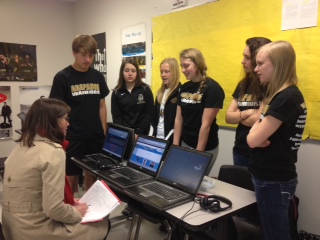
The Toronto Public Schools' School Board and teachers came to visit Littleton Public Schools in early April to see examples of exemplary technology use in education. The group stopped by AHS for presentations from our 9th graders on the various ways we use technology to enhance our learning.  We created a presentation fair. The kids broke up into groups around the room with each group selecting one project or idea they wanted to showcase to the touring group.  Accolades were bestowed upon the kids numerous times from the group attending.  Way to rise to the challenge Warriors!
Renee Howell speaking with the students after their presentation

Maggie and Emily presenting on TED talks

Rachael, Cole, Brooke, Savannah, and Jordan presenting poetry

James, Madison, Bekah, Jacqueline, Sarah, Ellie presenting on Wikified Research Papers

Wikified Research Paper presentations

Presentation Fair: kids leading the way

Brian, Troy, Marco, and Lauren presenting about Loggel
Monica, Sam, Emily C and Jeremy presenting about scribing, Google calendar, and Google Presentation

Amanda, Meagan, Cassi, Hunter, Zoey, and Maddie presenting about QR codes and banned book movie trailers

Zoe and Mackenzie presenting about CoveritLive and skyping with authors

Sanjay, Andrew, and Colin presenting about Chicago 7, Marcus Yallow, and Ned Kelly presentations

Spirit of Littleton Dinner


On Saturday night, Littleton Public Schools held its annual Spirit of Littleton Dinner which benefits the LPS School Foundation.  Our kids have participated every year showcasing their tremendous work using technology to demonstrate their learning and understanding.

This year was no exception that our kids were one of the highlights of the night. One attendee after another complimented our presenters on their articulation, communication, personality and understanding of what they were presenting.  Our kids rocked as always. I am always so impressed by our kids' professionalism.  Way to go Warriors. We are so proud of you!

Tuesday, March 06, 2012

Lucid Chart

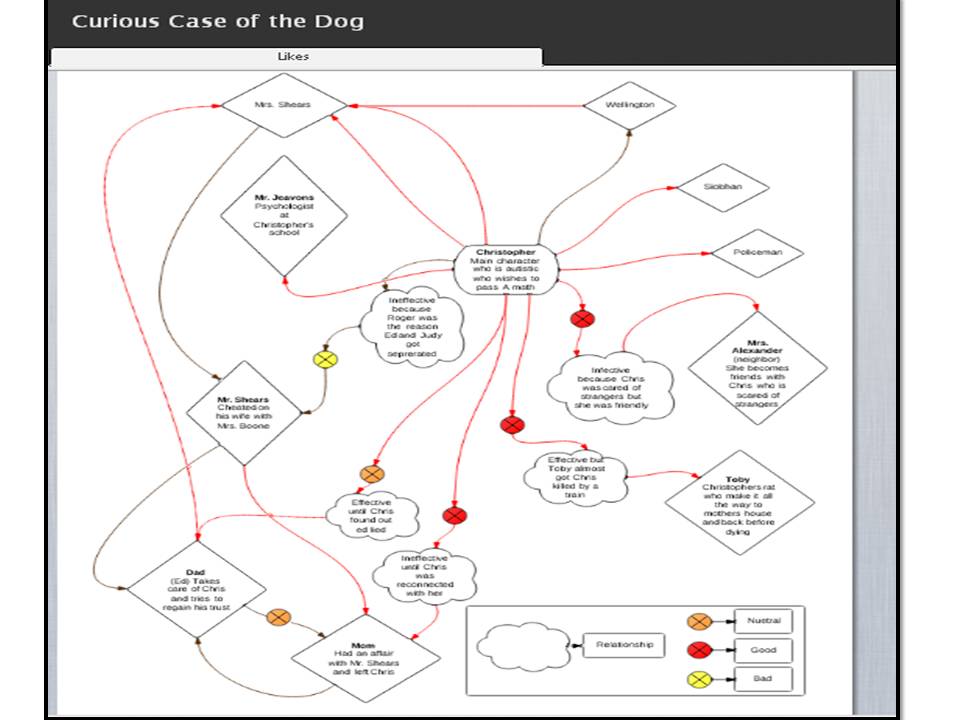
My all boys' class has been reading Mark Haddon's Curious Incident of the Dog in the Nighttime.  We also started our essential questions for our following units: Why are relationships so difficult?  What do relationships reveal about who we are and who we want to be?


Throughout our study of Curious Incident, I asked the kids to keep a relationship chart of all the characters. They needed to identify who the main characters were, give a description about the characters, how do the characters relate to one another, explain whether or not the relationship is an effective one or not, and why. Instead of writing this all out, I asked the kids to graphically show their understanding of these relationships.  Previously, I have used Webspiration for this project. However, this year I discovered Webspiration was no longer free. So, after speaking with Dana Levesque at our district office, she pointed me in the direction of LucidChart. She hadn't used LucidChart, but wanted to see what we could do with it.

It was fantastic!  It did exactly what the kids wanted it to do. They could assign shapes to characters (there is a plethora of shapes to choose from on the side bar), assign colors to relationships (Christopher, the main character in the book, assigns colors to good things and bad things so the kids wanted to mimic his likes and dislikes), create lines connecting the characters (they could use colored lines, dotted lines, arrows, etc...), add legends and keys to explain their thinking, etc... The kids could take the program exactly where how they wanted to showcase their learning and understanding about relationships from the novel.  Additionally, since we are a Google Apps for Education school, the kids could automatically sign in with their Google Account- no need to create a separate log-in! Finally, the kids can share their projects with one another. They can invite others to graph their charts collaboratively.

A couple of things that I would like to see different- it is hard to see all of your connections on one screen.  We are presenting 5 of the relationship connections in class right now, and we are having to move the mouse around to get to all the relationships they want to talk about. Secondly, LucidChart limits the number of connections a student can make on each chart.  60 pieces is all they are able to display.  Finally, under the free account, they are only able to create 3 charts and only share with three people.  However, it is a free program!

Here are screen shots of some sample kid projects:
Dan M- part 1

Dan M- part 2

Will B

Lou
Austin


V's TCAP speech

About a week ago, our fearless TCAP leader Kevin Kolassa, asked if I would give a speech to the school inspiring the students to do well on our standardized test the TCAP formerly known as CSAP. About 4 years ago, I was asked to do the same thing. At that time, I wrote a Star Wars themed speech. A few years before that, my friend Adam Wallace and I co-wrote a piece on the top 10 things worse than taking CSAP. After writing both of those pieces, I knew I wanted to do something more than just the standard inspiring quote driven speech.  I also knew I better not cross the line too much...

As my husband and I were talking about speech ideas, I asked him what he would think about me doing something based upon Guy Fawkes' speech from V for Vendetta. He thought it was a great idea. So over two dinners, help from a waiter, listening to a sermon and a lot of dictionary time, I wrote the following speech: (parts are borrowed from V's speech to Evey)


Evey:Who are you?
V. : Who? Who is but the form following the function of what and what I am is a man in a mask.
Evey: Well I can see that.
V. : Of course you can, I’m not questioning your powers of observation, I’m merely remarking upon the paradox of asking a masked man who he is.
Evey: Oh, right.
V. : But on this most auspicious of days, permit me then, in lieu of the more commonplace soubriquet, to suggest the character of this dramatis persona.
Top of the Tuesday to you terrifically talented TCAPers!  Today you are tasked with a tremendously taxing testament of your tenacious take-aways from your talented teachers.  The tactics that you try today to transfer the tutelage of teaching to the TCAP test must be tip-top.  Take your time TCAPers!  Trusted treatment of the timely tenets must be taken with treasured tactics and no tangential turns.  To tackle the TCAP is to not be a tyro amongst timid test takers.  This test will surely indicate your test taking tenacity; no doubt, you will triumph!  This troupe of teens is tried and true. You are the top-most!  Do not allow the tick, tick, ticking of the time to deter your opportunity to teem your knowledge.  Tiny twinkles in your synapsis teem with tidbits of truth-bestow these on the TCAP!  Tell me, would Tim Tebow be timid at a time like this?  NO!, Tim Tebow would be a tour de force, a terminator of the TCAP simply turning the test to toast with his tell-tale Tebowing
TCAPers- tarry no longer; tame the TCAP.  Take down the TCAP!  This is a tribute to your true temperament in test taking. The pain is temporary; the glory is titanic!
Evey: Are you like a crazy person?
V. : I’m quite sure they will say so.
Remember, remember the sixth of March.

Intelligence, curiosity and TCAP.I know of no reason why intelligence and curiosity should ever be forgot…

Hopefully, it inspired the kids to do well on their test. Many thanks to Maura for being my Evey!

Monday, February 27, 2012

Teachers helping teachers (and students....)

One of the best agreements we have come to in our 9th grade PLC  is asking fellow 9th grade teachers to come into our 9th grade classes and offer specific writing instruction on their unscheduled time. In the 9th grade, we have a large five paragraph persuasive research based paper we ask our students to compose. This is the first time in many of the students' lives they have ever written a paper of this magnitude. With many of our classes at 28-32 kids, our one to one time with our students is extremely limited especially to give immediate and focused feedback.   Typically, the writing unit takes six weeks of every day writing instruction.  This is an incredible amount of instruction time focused to writing the persuasive paper.

At our January PLC meeting, we addressed this problem. How can we give our students more writing feedback and, at the same time, not sacrifice additional classroom instruction time?  How can we best meet the needs of our struggling students who are falling behind in writing and, at the same time, push our advanced students ahead in their writing?  How do we give our students the one to one time they deserve?

In order to best facilitate the time our guest teachers were giving up to come into our classes, we have asked our students to prepare focused questions based upon their writing. Did they want help with organization? topic setences? thesis statements?  word choice? fluency?  connecting ideas back to thesis? etc....Then we broke up the class into equal sections based upon the number of teachers coming into class so each teacher had the same number of kids to work with.

Maura Moritz helping a student

Lauren Lee helping another student

Ethan Kuhlmann helping a student

Audra Buchwald helping a student

Abby Hancock helping a student

Greg Trotter helping another student
Although we have writing lab which is available on Tuesday and Thursdays to all students, and we peer edit in class, we realized we needed more direct instruction in class with kids who weren't seeking out additional assistance.  This was an amazing experience for the classroom teacher as well as the guest teachers. We all learned from this learning opportunity. The kids appreciated all the direct feedback and the guest teachers were able to let me know of issues they saw with specific kids, or of areas where they were really seeing kids excelling. I hope this is a tradition we will continue.

Google Map versus Google Earth

For the past few years with our study of The Odyssey and Into the Wild, I have had my students use Google Earth to trace their own personal learning journey along with the characters in the literary works we are reading. This assignment has evolved over time to now work with tracing Christopher McCandless' journey in Jon Krakauer's Into the Wild.  At the suggestion of Dana Levesque, I switched from solely using Google Earth to this year using Google Maps.  The advantages were great.

Google Maps allowed for the kids to store everything online versus having to save folders and KMZ files with their Google Earth work. Additionally, they could collaborate on their maps with others. I didn't use this feature this year, but am thinking of adding it to the maps next year in order to foster collaboration with classmates.  This will also help them connect with one another and discuss McCandless's choices. We do each entry differently with some as formulated paragraphs, but others are images, quotes, and reactions.  Google Earth and Google Map allows for the entries to change and adapt to the individuality of the student. Here is the rubric I use for the Into the Wild Google Map/ Google Earth project.

Google Map examples:

Chase

Jack

Tyler

Google Earth example: 2012

Austin

Google Earth examples: old

Tuesday, January 31, 2012

Skype Session with Cory Doctorow

Today, we had another intellectual learning adventure. Cory Doctorow, author of Little Brother, talked one on one with our 9th grade Honors students about issues ranging from Homeland Security, the English government, inspiration for the book, teenagers, connections to 1984, technology and his personal definition of trust. Our kids never fail to impress.

In the one hour session, they asked dynamic and thought provoking questions. Cory fielded each question with such intellectual purpose and directness, the kids were in awe of his intelligence. He truly lives up to his words he left our kids with, "Be intellectually curious!" He proved his point well by being himself.

 Thanks to Cory for making this possible and for Karl Fisch for supporting Maura and my efforts to connect the kids with real life examples of intellectual giants. I am so impressed by authors being their own person, by being upfront and at the same time charismatic with the kids, and by giving kids insight into what it means to live a life filled with challenging curiosity and passion.
 
Ustream of conversation
Cover it Live to conduct live blogging conversation
Tweets of Doctorow's comments and kids' questions

Friday, December 02, 2011

Serendipity


Serendipity: 

ser·en·dip·i·ty/ËŒserÉ™nˈdipitÄ“/

Noun:
The occurrence and development of events by chance in a happy or beneficial way

A couple of months ago, I sent out a blog post looking for classrooms that wanted to participate in our This I Believe Goes Global project.  We had more responses this year than any other matching up classes from Poland, Saudi Arabia, Mexico, South Korea and all over the United States.

As Karl and I were sorting through the responses. We notice one response from a teacher named Jeff Boyce.  About three years ago, we had a teacher named Jeff Boyce here at AHS.  Karl and I wondered if this was the same Jeff Boyce.  So, after an email exchange, we discovered it was a former colleague now teaching in South Korea.  Serendipity #1

My all boys' class was matched up with Jeff's class in South Korea at the Korea International School.  I knew that my all boys' class was going to be writing their "This I Believe" essays on something important to them, something they strongly valued.  Jeff let me know early on that his class was going to be writing their essays with a slight twist to the assignment: "I Believe in Evolution...".   To help you understand his requirements for their essays, Jeff is a science teacher, thus they were going to be writing about evolution.  Serendipity #2

Now, to make this collaboration even more interesting, my all boys' class is currently reading Jerome Lawrence and Robert E Lee's Inherit the Wind, a play based upon the Scopes Monkey trial of 1925 and the teaching of the theory of evolution in a fundamentalist Christian town. Serendipity #3

To prepare for our reading of Inherit the Wind, and help my all boys' class understand what John Scopes and Bertram Cates were facing with teaching the theory of evolution, I brought in one of our own biology teachers, Adam Wallace, to talk to the gentlemen about what it is like to be a modern day biology teacher and the theory of evolution.  Serendipity #4

A few weeks ago, after Jeff and I figured out the logistics of our timelines, I asked Jeff if it was possible for him and his class to Skype into our class here at AHS.  I didn't know upon asking him what the time difference was between Seoul and Littleton, CO.  Jeff talked to his kids. They were all willing to stay up till 1 am their time in order to Skype into our class.  We planned 1-1 connections with a kid from Seoul to a kid in my class.  Serendipity #5 (more forced Serendipity, but it goes with the theme of this post)

I talked with Karl about whether this would be possible with our EEE's and their built in web-cam. He assured me we could do it, we just needed to test out the Skype feature since Skype and the built in webcams  hadn't been used before. We practiced in class with one another everything seemingly looking splendid.  Then came the test call...

Jeff and I decided we should do a practice call before the big day.  Wednesday he had a group of kids call into my class first to me on the teacher computer and then to each of the kids they were assigned to.  The calls to me were flawless with our wireless system.  However, problems arose with the calls to the individual students in class.  We could hear and see the kids in South Korea perfectly, but they could only see us, there was no sound!  Oh no...

So, I asked some of my kids to go and get Karl to assist with our technical difficulties. Some of my boys have Karl as their math teacher and relayed to me that he had a family emergency and would be gone the rest of the week.  OH NO....

I sent off a couple of emails to our district personnel to seek out some help.  Later that day, after I had chewed my fingernails down to the nubbins and aged myself another 10 years, I got an email back from Rody Smith.  Rody brought over two other district tech folks to help me solve my problem with the sound.

At 7:30 am Thursday morning, after being told what I wanted to do wasn't possible, somehow the thoughts shifted to make the impossible possible.  Mark Lindstone, Randy Stall, and my favorite Rody Smith figured out a solution to the problem. Rody imaged a brand new set of EEE's for my gentlemen. Our library lent us enough USB headsets for each kid to have their own. Additionally, Rody delivered the brand new EEEs to AHS, helped me set up the classroom with a wired switch for all 24 netbooks (we decided to move from wireless one to one connections to wired connections), and managed to help me facilitate the day today.  Serendipity #6

I relayed all the events of Thursday morning to my all boys' class during our class time on Thursday managing to break into tears in front of them.  I stressed to them the importance of what we were about to do on Friday, the opportunity that this presented to them as men, as learners and as agents of change. The pressure was on! Since it is an all boys' class, I reminded them that this was like preparing for game day. We needed to prepare ourselves for the challenges but then also embrace the opportunities as well.

And how did it go? It was awesome- we even had cookies and juice thanks to one of our moms.  The kids connected both technologically and literally. They didn't stop talking until I told them that we needed to start wrapping up things. The discussed their essays, their lives, their schools, their interests, and their beliefs. They changed the world by getting to know one another, by shaping one another's understandings and learnings. I couldn't stop smiling and neither could the kids. The kids started talking one to one, and before I knew it, they were moving around the room talking to all the other South Korean students. What a fantastic day. What a fantastic learning opportunity. We couldn't have done this without the help of Jeff Boyce, the students in South Korea, Rody Smith ( my all boys class voted him as President for all his hard work), Mark Lindstone, Tracy Murphy, Karla Brachtenbach, Mr. Booth, Karl and of course my gentlemen.  Serendipity #7 (which just happens to be my favorite number).

Here are some more pictures of the day...


Test call on Wednesday
Jeff Boyce and I excited to listen to what was happening in class


Wednesday, November 09, 2011

The Smitty...

My kids decided they needed to create an award in recognition of the best banned book movie trailer for our Banned Book assignment.  So, they created the Smitty- combination of me and Wonder Woman. I send along pictures later.  What I really wanted to share were some of the best trailers. And the Smitty goes to two of the following....

 Best videos: Emma
 
Best video: Alex

Best videos: Alison
Best videos:  Grant
Best videos:  Liz
Best videos: Brooke
  
Best videos: Maddie D

Best videos: Cassie(all pictures were hand drawn)
Best videos:  Zoey H
 
Best videos:  Brian H
.
Best stance: Sean and Delaney


Best Why Banned: Bekah

Friday, October 21, 2011

Banned Book Movie Trailers and QR codes


About a month ago, Karl Fisch sent along a tweet from a librarian in Grand Junction, Becky Johnson.  Becky was creating QR codes to go along the spines of books in her library. The QR codes linked to YouTube videos students had created based upon the books.

After expressing my interest in building from Becky’s work, Karl contacted her to gain more information about the coding creating process and help us get started.  I thought I would pass along Karl’s questions as well as Becky’s responses:

  1. What site are you using to generate the QR codes? I know there are a bunch, but thought if you had one that worked well, we'd use that.
    1.  I use Kaywa QR-Code Generator<http://qrcode.kaywa.com/> - No registration or download needed, just paste the link to the site you want to generate the code for, choose the size and click generate.
  2. Any advice on printing? My concern is getting them small enough to fit on the spine of a book but still be a functional QR code.
    1. Printing is easy.  Copy (copy image) the code and paste into Word or a Google Doc.  Resize to fit the spine and print.  I've made them as small as a half inch square and never had a problem scanning them. Just make sure you re-size proportionally.  I use the ScanLife app on my Android phone, but I've seen kids use other apps and the Google Goggles App works too.  I just print them off on a laser printer and fix them on the spine with book tape.
  3. Did you do book trailers at YouTube, or did they create a site to host the videos, or what? Any links to samples you might share?
    1. I've got kids who've created videos in Animoto<http://animoto.com/>, FlixTime<http://flixtime.com/>, Photopeach<http://photopeach.com/home> and Photostory.  It always works better if they can be exported or saved in a format that can be uploaded to YouTube, however I've included some examples that play in the native app, like Photopeach and FlixTime.  I sometimes create codes linked to student blog post book reviews, so I've included some examples of those.
  4. Anything else we should ask but I haven't thought of?
    1. 4. Problems encountered:

       *   As long as kids have devices with 3G or 4G access, Android or Apple, they can view YouTube videos and they always load quickly and play well.  My district's wi-fi blocks YouTube (grrrr), but the kids tend to loan devices to each other to enable scanning.  The QR codes are fairly new and I don't have a lot of them on books yet, so it is the geeky kids that are accessing them right now.
       *   Animoto is my favorite site for students to create book trailers, but I can't get codes linked directly to the Animoto site to play on some devices, so I always export or upload to YouTube. Using the Animoto Educator Plus Account<http://animoto.com/education?gclid=CJ6eiZmMyasCFaUCQAodPg992Q> allows students to make videos with no length restrictions and they can be exported directly to a YouTube account (if the student has one) or saved as an mp4 file, which I can upload to my YouTube account.
       *   I've tried uploading to SchoolTube.  The codes and links work fine, but the videos take forever to load and tend to look wonky on a device.
       *   The flash-based videos in PhotoPeach and FlixTime don't show on Apple devices.
    2. Samples: https://docs.google.com/document/pub?id=1e9_OFRb7ph_qnWfDaOA1yl-dM7h12XOgwOn_zjBzPc4
During the month of October, along with our study of Ray Bradbury’s Fahrenheit 451, we read banned and challenged books. The kids print off a permission letter from our webpage getting their parent’s approval on a banned or challenged book they wish to read.  In year’s past, we have had the kids complete a banned book project where the students create a visual on their desk space presenting the book, the research on why the book was banned or challenged, and then, take a stance on whether or not they agree with the banning and challenging.
After hearing of Becky’s school’s work, I threw out the idea to Maura Moritz( my partner in all things 9th grade Honors)of our kids making movie trailers for their banned/challenged book. The kids were ecstatic about the thought of creating a movie.  We worked with the original rubric for the project, and adapted the rubric to fit our new idea. The kids wanted a lot of freedom in determining what parts of the project could be video and what parts could be still written. I thought this was important since some kids didn’t want to publish to the world their belief on whether or not a book should be banned or challenged.

To make this new project even more serendipitous, at parent teacher conferences, one of my student’s mom happens to be a creative director who has created a number of commercials and worked with movie trailers as well. Mrs. Friskey offered to come into class and help the kids think about movie trailers offering up her feedback to the kids. This was an amazing opportunity.  It helped the kids and myself refine the project even more.  Here is the new rubric based upon her suggestions and tips to the kids.  Also, here is some of her sage advice to our classes:
THE GOLDEN RULE of ADVERTISING
Mention/present your product and share its information/benefits in the best creative way to garner the desired response.
What Makes a Movie Trailer? (think of a movie trailer as a tease)
(Mention Product) The name of the movie (book)- this often appears at the end of the trailer. 
(Info/Benefits)  Plot points or cool prestige elements such as the director’s or actors’ names. Be careful not to give away whole story.
(Creative) Exciting editing, clever copy, memorable scenes or dialogue, compelling music. Most important to storyboard out idea.  Think about using catch phrases (powerful quotes), use imagery (taste, touch, see, hear, smell), LESS IS MORE
(Desired Response) TICKET SALES! Money? Get people to read your book?

She is also offering to stay in contact with the kids while they are working on their movie trailers. They can even post questions to her.

We watched some movie trailers in class today (http://www.youtube.com/watch?v=kHRf01Gjosk  http://www.youtube.com/watch?v=eOL-wZSCn_g  http://www.youtube.com/watch?v=NqfuzkeCJ8k and  http://www.youtube.com/watch?v=tnWu1sLtgI8) to stimulate our thinking towards creating movie trailers.  Next week, we have one day in class where we will be solely working on the movie trailers. Other than that day, the kids are completing these projects outside of class.  The kids can use any video production software they desire. We have flip cameras available to them for check out as well.  Some kids are using my Animoto educator account to create their films; others are using MovieMaker, iMovie or Photostory. 

We plan on having a movie watching day with a special award for best trailer.  Karl and our library/media specialist, Mr. Tracy Murphy, will help the kids create the codes.  The kids are submitting all their projects through a Google Form to easily collect their masterpieces. I will post our results as well as feedback from the kids when the projects come in on October 31.