Tuesday, September 25, 2007

Personal Learning Network-Presentations


Last Friday, I had our first group of students present on their personal learning network. I used this rubric to evaluate their presentation as well as had the class access the student blog he/she was referencing to leave real time comments about the presentation( we pulled up the blog and had it appear via our overhead projectors). While the student was speaking, the class reacted to the presentation. The instantaneous feedback the students provided was valuable to the presenter. If a classmate did not feel comfortable offering oral feedback in our class debriefing, the evaluator could reference his/her blog and see what reactions the class had to the presentation. Here are some examples:

seanb said...
Brandon good job presenting. you had a clear voice and didnt studder or fidget. But next time try and be more descriptive and dont fade off reading the story.

laurene said...
brandon! Good job on your presentation. Your pace on your speaking was good and slow so I could really understand you. Your eye contact with the class was also good. I also really liked how you compared your article with your history class and your english class and you went into details with how they relate to the article. I also think that you should try not to fade off win speaking and try to speak a little clearer, but other than that good job.

berekm said...
Anna, You did a good job speaking loud and clear so everyone can hear. I liked your relations with the story about taking pictures of landscapes. I think its funny that you thought New Jersey was New York. I agree with you becuase people do take the easy way out and also students do it too. I understood everything you said and i agreed with the getting pictures online. You looked up while you read and talked to the class as if you memorized the writing. You added an interestin personal aspect to your presentation, good job.

avereel said...
Anna, I really enjoyed your presentation. You really got into detail about how it connects to the world and to yourself. You were so calm about presnting, you were so brave to go first! I totally agree with what you said, too many times, we do take the easy way out. I haven't read My Flickr Conundrum, but your presentation made me really interested. Good job!

annies said...
Alex! Good job explaining the article. I agree because students in the US should have a high literacy rate, and then people will see them as "Kids of the future". But i think it could have been a little longer, and you could have related it to the world and yourself. But otherwise, good job!

Xavia H2011 said...
If you have your notes, try not to look back and forth to the screen and your notes, just choose on. Good job though, your blog was well explained and it was good how you related it to yourself. Try to make it a little longer to.

I also asked for the presenter to add an additional blog entry to their personal blog critiquing his/her presentation. I think it is important for them to reflect on their preparation as well as evaluate their delivery and effect of the presentation. Thinking out loud, it might be interesting to do some goal setting before their presentation on what they hope to achieve in their personal blog and then assess that piece afterward in a reflection blog. Here are some examples of their personal reflections:

Anna K, Overall, Friday's presentation was pretty good, but I still need to work on not sounding so nervous and fidgeting so much. I think I did a good job at keeping eye contact with everyone and not talking to fast which I normally do.

Josh TS, For my next presentation I would like to do a few things diferently, first of all I would liek to be more prepaired with note cards instead of reading off the screen. I would also have like dto have a longer presentation

Alex E., After presenting my PLN in class, i think that i didn't prepare enough, by practising talking and have the materials needed, and my writing didn't have enough detail in it and could have been longer. Also i could have spoke up more and made more eye contact, and work on not saying "ummm" and "like" so much. But besides that i have learned from my mistakes and now i know how to prepare for my next presentation

We have some work to do on the reflection side, but hopefully we will get to some honest feedback on what they did and how they can improve after we practice what good reflection looks like. I am also going to add podcasts of their presentations to their own blogs as well as to Learning and Laptops for them to reflect on. I think this is a valuable piece to a reflective evaluation be hearing what you sound like when speaking in front of a group.

Some changes I decided to make to the presentations after conferencing with Jessie Comp about her classes presentations were that the students need to speak about all their blog postings. I am not sure how this will work out once they have numerous entries but I like the freedom it grants them in their presentation. Also, I am asking the presenter to create follow up questions to their presentation to create a post-presentation dialogue with the class. After all, one of my focus points for creating a Personal Learning Network is to get my students talking about issues that are relevant to them. Jessie had great success with this in her class and I am hoping to create the same dialogues in my class.

Thursday, September 20, 2007

Lab

So today, I tried something new. I know, me?

I created a new blog for my Advanced Placement Chemistry Lab students. I had one group volunteer to keep a video/pictorial record of their actions in lab. I even allowed them to repeat the demonstrations that I did at the beginning of the class. One member of the group kept a typed record of what they were photographing/videotaping and then that student is going to send it to me tomorrow. What my plans are, and I need a little help figuring this out, is to post this information in a blog so that we have a record of all the things that we do this year. I just am not sure how easy it is to post video to a blog. Is there another format that I could try? Are there teachers out there that have done things like this already?

I know that when the wireless network is running I can hav ehte students post directly as they are doing the experiment, but what are some possible work arounds right now?

Monday, September 17, 2007

Google Earth meets the Odyssey

During my first few years at AHS, Maura Moritz and I developed an assignment where we had our freshmen complete personal learning journeys on big laminated map mimicking Odysseus own journey. Along the map, they had to carefully mark 10 places they had visited, what they did there, as well as what they learned from the experience. We displayed the maps around the classroom and everyone could marvel at all the places their classmates have traveled.


Once I was introduced to PowerPoint, I updated this assignment to the use of PowerPoint complete with linking slides and maps. However, this past spring, I watched a presentation from Mike Porter about his use of Google Earth and saw how The Odyssey Personal Learning Journey could take on a whole new level.


My students will be creating a Google Earth journey of their travels following the same criteria as before looking at where they went, what they did there, and most importantly, what they learned. Odysseus during his travels learned something about himself as well as other cultures along his journey home, and I hope they will do this as well. I am hoping that these will be true reflections of their learning. Also, I am anxious to see the impact that these presentations will have on one another. Will they find they have visited similar places? Will they see and reveal the lessons they have learned over their short life thus far? Putting together my presentation did that for me. It was difficult to recall some moments, but allowed for me to really laugh and appreciate all I have been through. I would love to know suggestions others might have for this assignment. Although mine doesn't contain pictures, video or audio, these are things I am thinking of adding to their presentations.

Here are their examples

A Twist to College Essays- Using Google Groups


Google is taking over our senior essays!

Michele Davis, Lauren Gaffney, and I were interested in approaching our senior college essay unit differently this year focusing on more collaboration work done outside of class. Typically, we have our students compose a series of essays of which the teacher responds and provides feedback to the student. For my class, my students write three essays dealing with either a crossroads in their life, how have their parents impacted them, and a who am I essay.

Over the years, I have changed the focus of the essays to meet the needs of the colleges they are applying to, but for the most part in the past, it has been an out of class, teacher to student assignment. To give myself some credit, I do have them use Word’s reviewing toolbar to peer edit one final paper in class. Also, I have them conference with me about their final essay before they turn it in so we can discuss changes one on one.

However, even with all this work, Michele, Lauren, and I wanted something more this year from our seniors. We wanted them to connect with one another and see what their peers were saying. Last year, Michele had used Google Groups with her seniors to submit their essays online so that their classmates would be able to provide valuable feedback to the posted work. After discussing how to do this, we came up with the following criteria so that our combined 5 sections of seniors could upload, comment, and read their peers work. We had some basic criteria in completing this assignment:

Post one final essay

Students can choose to post anonymously. We actually came up with a coding system of the teacher’s last name followed by a number (Smith 4).

Students could choose to use their names to post, but no last names. (Anne S)

All students needed to post their essay by the same date.

Students need to give constructive criticism and valuable feedback to at least 5 other essays. (These essays need to be students in other classes)

Constructive criticism needs to be memorable and helpful.

Try not to comment on essays that have already received feedback. If an essay has received 3 comments, move on to another essay.

I will have my students blog about their feelings on this assignment, but most really felt the process was helpful. Some suggestions that we need to think about next time we do this:
· What does constructive criticism look like? Some kids received valuable feedback while others had no comments.
· Clearer identification of who is in what class.
· Do we want to open up the essays to a larger audience?

Overall, I think we are on the first steps to a really valuable and interactive assignment. I really feel that in order for the seniors to become the best writers they need to read what other students/ writers are producing- as well as the great writers of literature (We don’t want to forget Oedipus’ memorable crossroads or was it a fork in the road). This assignment enabled them to do so. In fact, when I asked them if they would want to put their essay out their for the whole world, many said yes, but only if they could go back and make the changes that their peers had suggested as well as what we talked about in our teacher student conference.

Michele’s comments on set-up and process…
Building this site was quite simple. Google groups make it easy and user-friendly. Google groups also provide pages to help users navigate their way through the site. One such link is the Google Groups Quick Start Guide. Google groups has 3 easy steps to follow to start: 1) set up the group (name it and decide who can view the site), 2) add members (if you like), and 3) add information to your page (add additional pages, upload information, change the logo, change the access, etc.).

We decided to set our College Essays site up so that we did not have to invite students; they just needed a Google account to sign in. If students did not have an account, we had them register for one. (One somewhat annoying aspect was that every time a student puts their paper (adds a page as Google groups calls it) on the site, it emails the managers.) This was a little bothersome, but it did show us who was responding by the deadline.

Overall, I love how this site provides an opportunity for students to place essays and get feedback from multiple readers. And, for this assignment, students go feedback from students in other teachers’ classes. The benefit, we feel, is that we all teach the college essay a little differently, so students from other classes will notice different things, find different areas to improve, etc. Since this was the students’ first drafts, we did not prompt them on what to respond to; however, next year, I would like to have 3-4 things for the students to critique in particular: voice, narrative, word choice, and getting to know the student. Students, for the most part, were specific with their comments, but I think it could be more focused.
Lauren's comments on the process...
Much like anything one tries for the first time, this Google groups experiment had both successes and failures. In terms of successes, some students received up to eight full paragraphs of comments. In previous semesters of teaching the college essay, students would have received feedback from a teacher and from one or two peer editors. In contrast, this Google groups assignment provided feedback from me as well as up to eight peer readers. Another positive students mentioned was that they could edit their essays with each piece of feedback they received as the Google groups’ pages function as Word documents. If students were struggling to think of a writing topic or a way to approach the topic they had chosen, this assignment also allowed them to scan hundreds of essays for ideas.

For next year, I will have students comment on three essays instead of five so the feedback is more authentic; several students felt like five comments were too many and that peer readers started getting lazy with their feedback. In addition, I would spend a class period talking about how to give good, specific constructive criticism based on the final rubric on which their essays were graded. Another student suggested that teachers comment on the essays of students who are not in their classes so writers not only receive feedback of students outside of their class, but also receive the opinion of another teacher.

Sunday, September 16, 2007

Electronic Essay Editing

I am a student in Ms. Smith’s 9th grade honors class. This past week we wrote essays comparing 3 film versions of Macbeth. After writing our essays, we put them on USB drives and brought them to school. We then uploaded them from our USB’s and exchanged papers. This way we could take them home and edit them on the computer.
I personally like this process. It was fairly quick and easy. In previous years, when writing essays, I had to print mine out and physically give to someone to take it home to edit. Many times the person editing mine would lose it. When putting on the USB, it was easier to keep track of.
Plus Ms. Smith showed us how to make comments on each others papers (click view, toolbars, reviewing, and use the icon of the folder.) I liked this because it allows you to highlight errors or make suggestions without actually altering the person’s paper.
In the end, we were able to return the persons paper and remove it from our USB. It was a simple and painless process and a lot easier than dealing with a hard copy of an essay. This is an excellent method of editing.

Thursday, September 13, 2007

After being introduced to online notations it is my personal opinion that online notation benefits my learning experience in a more progressive way than using the actual book. Online notation is being able to type annotations in comment boxes right along side the text. With the regular book I would have to use sticky notes and mark up my book with illegible handwriting. It is also very time consuming to interrupt reading the book to take out a sticky note, write your thoughts, and then continue on. With online notations I can type my thoughts directly onto the sheet without losing my train of thought. Something else I have found extremely helpful is that it is easier to clarify the content of the book through online notations. In the side comments one can work through their thoughts using the many resources the computer offers to understand the text. Everything is crisp and clear in an easy to understand format. It is easily transferable and my learning can continue without the aid of a teacher outside the classroom. Technology is a massive part of the world today and by incorporating it into the school systems that is truly preparing us for the future. Here is an example of online notation. I am able to work through what Macbeth is saying to better understand the text.

MACBETH
The service and the loyalty I owe,[k1] In doing it, pays itself. Your highness' partIs to receive our duties; and our dutiesAre to your throne and state children and servants,Which do but what they should, by doing every thingSafe toward your love and honour[k2] .


[k1]Feudal system. King Duncan has two sons Malcolm and Donalban. Thane is not that high in the system. But he owes his life to the kings his thane from when the king granted him land and Macbeth swore allegiance

[k2]Nice façade of complete loyalty when he was thinking of killing Duncan. Duncan welcomes him with open arms. His downfall is trusting too much.

Online Notations

In my opinion, the online text is much more convenient, useful, resourceful, and helpful. The text is more convenient in a way that you don’t have to go and buy your own copy of the book and carry it around with you with sticky notes and a pen all the time. I love having access to my notes whenever I’m near a computer. Even if I don’t have my notes I can always access the text online. It is more useful because the online has the option of having the new English right beside the old English where our book only has the old English. You have nothing to help explain the old English version. Some books do have both of the interpretations but the online text allows you to annotate and compare both of the versions without having to draw a line from one page to the next. How many kids get to say that when they were studying Macbeth they got to have their notes with them all the time, in an easy to edit format, and get to continue learning outside the classroom? All I know is that I am one of the few. I am usually a good student, but with the added technology my learning possibilities have doubled or tripled. Not that I don’t like learning, but it has become more enjoyable now because of my online text and notations. I have learned more in these last couple weeks than in most semesters of regular classes. It is such an innovation to have this technology in the classroom, let alone for freshman, but it really does seem like the logical conclusion when we step back and take a look at how our world is progressing. We have so much technology in our world today and it seems like the school systems are taking their sweet time catching up. Imagine how many more students would stay in school all the way through high school and into college if every kid had the ability to learn with a laptop and online information. Kids would no longer have to confine learning to the classroom – they would be responsible for their own education.

Sample PLN Entries...as promised

Jessie and I wanted to showcase some of our students' PLN entries. Please take a look:

Kelly S. wrote about Karl Fisch's Did You Know presentation,

There are things on there you wouldn’t have guessed, one that caught my interestwas that it said “if you are one in a million in China… there are 1300 people just like you” talk about having a twin! Some of it was more random than other stuff, but some was really just imaginative, but probably true. It talked abouthow in the “future” there will be a computer that exceeds the capability of thehuman mind. Now the first thing that came to me was; robots are going to out smart us and take over the world! Well I don’t believe that we know what we don’t even knowhow smart we are?! In my social studies class we were discussing all the stages we have economically gone through as a country, and even as aworld. There was the “cave men” age (I suppose), agriculture age, industrialage, and now the technological age. So what will be next? I don’t think anyonereally knows what next huge breakthrough we will make. Maybe something inmedicine, they could find a cure for cancer, which would change a lot of things!Or what if we were to find another world out there, this galaxy is huge, bigger than we can even comprehend. We’ve only studied our backyard, there’s a whole universe to explore! There is no doubt of how quickly and drastically we are changing economically (mainly technologically), so what will the world look like in just 10 years? Will I have a computer chip installed in me that connects me to anything or anyone within internet and communication devises? Will kindergarteners be learning to type, instead of write? Are these changes good? Orare we getting way over our head? I’m really not sure all I can do is I guess just wait and see.

Dennis K. wrote about a quotation from The Fischbowl,

If adolescence is defined as the "learning" stage in life, if middle- aged is defined as "the starting to get it point", and if old age is the "reaching death" point in life, then, I believe that America as a country is basking in the warmth of its middle period. When the lands of North America were settled by early English Pilgrims, the territory entered a new era in its time period. As America developed, many mistakes were made and many lives lost, but America persisted through its early career. It then arrived at its "proficient" point where it developed based on its own learned lessons of the past. America has not met its old age, for, it is in no immediate danger of becoming nonexistent or a lacking nation. When faced with the question of technology slowing or accelerating the “death” of a country, I will present the following. It depends. If the “death” is very evident and unavoidable, then the scientific and technological knowledge we as humans possess will not suffice in order toprevent a “death”. If the country is at a stage where it can see death in the future further away, scientific and technological advances may be able to aid the country in its climb towards proficiency. As normal “deaths” of nations are primarily caused by the poor marketing conditions and economics, technologicaladvances in goods may help companies sell more products, earn more money, and as a result, pull the endangered country out of jeopardy. Likewise, scientific breakthroughs may lead a country to fortune through the utilization of theirscience in sold products. Although science and technology can be used in such away as to postpone “death”, it can also be used negatively to speed the process.When products are stripped of their scientific and/or technological values,sales for the product will diminish. If enough products are affected, the process of “death” will quicken.

Anna K. wrote about Will Richardson's blog,

I have just finished reading a recent post by Will Richardson called My Flickr Conundrum. This blog raises a question about taking photographs of landscape. His question was, “why take pictures of places that you visit that probably aren’t going to be as good as the photos that others have already taken that are already available for you to use in your own albums, slide shows, whatever? I mean, unless you want to organize the wife and kids in front of the spot just to prove you’ve been there, what’s the point?” I believe the point is to be able to call the picture your own. You can always look up a picture on the internet, but if you do that, you are not able to say, “I was there and I took that picture.” It doesn’t matter if it’s the worst picture in the world, you can still be very proud of it.

Sam H. wrote about David Warlick's post regarding cyberbullying,

I read a recent article written by David Warlick in the 2 cents Worth subscription. This post is regaurding cyber-bullying and how it is still an issue, but now its not only children who are doing the bullying.I looked at that post and I realzed something. It is a lot easilier to cyber bully than we think. I have heard countless times that cyber-bullying is a major issue and because I havent been involved in it I don't tend to think about it, but maybe it is something that we need to start thinking about more now. Technology has taken over in our world today and now it is much easier to say things, over the computer or maybe even texting on a cellphone, that you wouldn't say to someones face.Now we ask ourselves, why is it easier to say things over technology than to someones face? The reason that was brought up in this post is people feel more comfortable over the web or other forms of technology because there is a physical distance between the two. People feel more comfortable saying harsh things when there is distance between them because they arent afraid of the consiquences.How does this matter in the world? Now that technology is booming more and more adults are beginning to use technology for various forms of communication; thereforethe right of cyber-bullying in the adult ages has increased. Now we ask ourselves, with this technology how are we going to be able to lessen the rate of cyber-bullying among adults and children? The answer I am not yet sure of.

Wednesday, September 12, 2007

PLN-The beginnings

We are on the road to beginning our adventure with students developing their own Personal Learning Network. Karl Fisch wrote about this on The Fischbowl a few weeks ago and we received a number of comments regarding what we are going to implement. I have appreciated all the feedback and support. Jessie Comp, my colleague and friend, will be doing this with her class as well. Some other ninth grade teachers are going to try versions of this project (see Michele Davis).

I spent all day yesterday in class reviewing with my ninth graders the reasoning behind switching from outside reading books to Personal Learning Networks. I went over the handout and had them sign up on my Google Reader with their own personal blog which they will use to react and reflect about their readings. I then had them create their own Google Reader and began to add feeds from the online handout. Keeping the handout online simplified the process of acquiring the links to add to their reader. Then as homework, the students were supposed to read the posts in their Google Reader and react/ reflect to what they read writing about in their personal blogs. The question to react/ reflect on:
  • What did you read? Link to the article.

  • What matters from what you read?
  • How does it relate to what we are doing in class or in your life?
  • How does it relate to the world around us?

Finally, the student signed up to formally present twice to their classmates about what they were reading. The students are expected to be well prepared for these presentations. During the presentation, the presenter's classmates will access the presenter's blog and react to the present on the personal blog. I think this will provide valuable feedback for the students both presenting and viewing. It also enables the other students to see other feeds that they could add to their own personal learning network.

Today I finished logging in the students' personal blogs into Google Reader. I want to export all the student feeds from their personal blogs to the class so they don't have to add them one by one but can access the link on my web page and then import the feeds.As far as seeing how their homework went, I was impressed by how many went to their own Google Reader, read their posts, and reacted on their own personal blog. One thing I wish I would have done a better job with ( I am planning on doing this tomorrow in class) is go over the sample entries I created on our class blog- Sample 1 and Sample 2 Why spend the time going over samples? Well, it seems that from my experiences last year with ninth graders that they need me to provide more guidance and structure. I struggle with this philosophically feeling like I am showing them they way it needs to be done, but I am hoping with our conversations about this project being about them taking charge of their own learning as well as showing the world what they think, that my students will make it their own. I am really anxious about this project because I can see the amazing possibilities that can come as a result of them taking this project seriously. I will be posting some of their entries on this same post after I get through reading them. To be honest, on the managerial side, that is something I am personally worried about keeping up with. I guess I just need to relax and see what happens.

Monday, September 10, 2007

PLC questions

Jessie and Brian asked our 21c group to respond to the following questions regarding establishing mission/vision:
  1. When I leave this school, I would like to be remembered for...I would like to remembered for helping students and staff members reach beyond their potential. I want to be the person who helped them see complacency is unacceptable. I want to be remembered as someone who was innovative in their classroom and pushed students to achieve more than they thought possible. I want to be remembered as someone who not only taught but learned from her students and colleagues.

  2. I want my school to be a place where...it is expected to try new things, and that you are supported while doing so. I want my shcool to be a place where we trust our teachers to do thier jobs and trust kids to do theirs. I want my school to be a place of creativity and innovation. A place where learning doesn't seem confind to the bells of the school day. I want my school to be a place where we all learn from one another. I want my school to be a compassionate school where we care as much about the students while they are in our class as well as outside the class.

  3. The kind of school I would like my own child to attend would... be a place where they feel like they can grow as a learner and don't have to wait to for others to catch up (Emma wants to learn math right now, but her teacher told her she has to wait- they aren't there yet ), be a place where teachers are encouragers and motivators, recognize their uniqueness/individuality, appreciate the whole child not jsut the academic side

  4. The kind of school I would like to teach in would... be one that pushes and encourages me to learn more, challenges me to be the best teacher I can be, supports my family life time, encourages its staff to try new things, give time for teachers to talk to one another, trusts its teachers and treats them like adults(see T. Sale's post), 21st century ready-teachers and students with laptops, students and teachers see each other as continual learners, staff supports staff, students leave prepared with skills and knowledge that will allow for them to be adaptable/ fungable and a positive participant in their future, and one with windows.

This is just the beginning. I think it would very beneficial to have my seniors and freshman complete this from their perspective to see what they feel about school and they way it should be.

Thursday, August 30, 2007

What Matters

Last year, I had my freshmen all focus on the question of what matters. I was really glad to have one question on which they could focus all semester. Every project, assignment, class discussion all came back to this question. I liked this idea so much I am trying it again but with some more tweaking and focus. I realized that my freshmen need more examples and not quite as much freedom as I give to my other classes. It seems like they need me to provide a little more structure than what I would like, but I am hoping that by providing more illustrations of a possible end result, that their understanding and connections with literature will increase so much more.

The first part of the What Matters project is a creative, visual illustration of what matters to them. They always seem to struggle with this question at first, asking me, "Well what do you mean what matters?" I simply respond with, " I don't know, what matters?" They, of course, are confused and perplexed. This year after going through the same conversation with them as my last year's 9th graders , I decided to create my own example of what matters. I think this gave them some better direction, but I still have my reservations. Many of their posts seemed similar to mine (I am not trying to be egocentric here). I am just having a difficult time trying to find the line between feeling like I am leading them to the answer I am looking for (i.e. my what matters example) and having them struggle to find their own understanding- what I feel like they should be looking for. I know that this is the beginning of a new year. I just need to keep myself focused on the idea of showing them the possibilities and providing the structure for them to come to their own understanding. I guess it is just one of those ho-hum moments.

I am feeling frustrated today; frustrated by the fact that after giving them many days to complete the What Matters visual project, many were not done. They just chose not to do it. Was it because it wasn't a meaningful project to them? Did the technology get in the way? What was the hold up? Well, I asked them...and their answers varied. They all liked the project, thought it was better than other assignments, but just chose not to finish it on time. What is happening to these kids? To totally digress for a moment, this is why I don't believe in giving kids extra time on assignments. What did they learn from turning it in late. NOTHING! In fact today, I had another assignment due where they were to look up and develop their own understanding of literary terms. About 1/3 of the class didn't even bother to do it. I couldn't believe it. Two days in a row, and even after we talked about getting things done on time, and they still couldn't finish the homework. Just rants from the trenches today.


But, to end on a positive note, please take a look at their visual what matters. Please, leave them comments and help them see the possibilities. Thanks!

Tuesday, August 21, 2007

Watching Zolli and reading about Death

Since I had seen Zolli first hand, I don't have much to say other than I remember walking away from the presentation thinking one, does this mean I am going to have to take care of my parents when they are older? and two, what does this mean for education. The fact of the matter is that if we are living longer, are we really preparing kids to be life long learners? I mean if they are living longer that means they are spending a greater portion of their lives outside the education setting, outside of being influenced by hopefully positive individuals. Are we giving kids in our classrooms today the skills they need to live a long and happy life? I feel like these are the changes we are trying to make at AHS. We are trying to show the kids how to be critical thinkers, how to collaborate, and how to be an effective communicator. This skills will help them no matter what the text they are studying or in what the job they are employed. As far as taking care of my parents (because as Zolli quotes this task usually lands on the female), it worries me. I know the cost of adult care facilities is increasing as much as college tuition. Will I be able to handle that responsibility? I know in my heart I would want to be there for them as they had taken care of me, but I wonder if I could really do it and survive. Stuff to think about for another time.

As for the article on death, it reminds me so much of Brave New World and 1984 two novels I teach. I think I will have to keep this article and have my seniors or 9th graders read it to get their reaction. I think about most teachers retiring around 60 years of age if not earlier. What are they going to do to survive financially until death rates of 80+? What is that going to do to the education profession if teachers are staying at schools until their 70's? Will we end up with a bunch of old teachers who are sorry to say "out of touch" with kids and what kids need to know? I am thankful to say, and privileged to know, that I don't see many teachers towards the end of their careers here at AHS who aren't still continuing to learn. That set such a positive example for the rest of us to follow. But back to the article.

I find it interesting how the author speaks of wealth flowing from older generations to younger generations, but now we will not see that happen as much. I have been thinking about this in terms of watching my grandparents (2 grandfathers who have already passed away, but two grandmothers still living- one 92 and one 87). I know the financial status of my grandparents as well as parents is much more than I could ever achieve especially considering I am a teacher. How can I give my own children more than what I had growing up? My mom and dad gave me more than they had, and I know their parents did the same but I am certain I will not be able to do the same for my kids. Am I sad about it? Not really, because I think I give Emma, Jack son and Will different things, but I do wonder about the change this will create in our society. Are we going to create a society of volunteers of caring and concern because people just can't give money to a problem?

Thoughts for today...

Wednesday, August 15, 2007

Beginning of Year 2

Reflecting on the jaw-dropping progress made with laptops in my English classes to enhance student learning, I can easily say I was impressed with what my kids accomplished and produced. I walked away from last year thinking, where do I go now? There was so much they not only did, but showed me about learning, about life and that possibilites are endless in what they take away and want to give back. They rose to every occassion presented to them and exceeded all expectations. So I am beginning this year with some trepidation.

Where do I go from here? Not only do I feel the pressure (totally self-imposed) to do more with these kids, but also to do more with showing others the possibilites and doors that open to students when technology becomes "flawlessly" integrated into their learning. In no way am I saying that I flawlessly integrate it, but I am working towards that goal. Also, I am really feeling the urge to expand my own learning. I have begun the journey into looking at graduate programs. I found two over the summer when I was in Atlanta with Brad, Brian, Karl and my roomie, Barb! One is located through Pepperdine Univeristy in Malibu (it would be a rough time staying in Malibu). The other is located in Pennsylvania called Wilkes University. Both have online Masters degrees (which at first sounded like the degrees you could get through advertisements on TV) but both programs seem incredibly well rounded looking at theory as well as technology. Much like what we are already doing at 21c, but I don't think I can get a Masters degree through Karl Fisch University yet. Umm, Karl?

So I guess what I am saying is that there is a lot going on in my mind. Go figure. I want to be better about blogging as a reflective tool this year rather than just posting student work, although I will still do that. I want to push myself as well as my colleagues into trying new things... personal learning networks, video podcasting, Skype conferencing with other classes. I want to learn from what my fellow teachers are doing. I want to get a better sense of my students. Last year, I felt so rushed to do things. I want to go more in depth with the kids, explore personal learning networks with my 9th graders, show my students what continual learning looks like, run a 7 1/2 minute mile 1/2 marathon.

I guess I better get started!

Monday, June 18, 2007

Great Tours

You might find it interesting to know that I teach a senior level astronomy class. You might also find it interesting to know that the students and I had a conversation that involved the idea of the students being producers of information and not just consumers. We talked for awhile about what this would look like in a high school class. The students decided that they wanted to create different types of documents through out the school year where they could show that they learned and understood some of the material that was presented.

As we looked at the different ways that astronomy impacts our lives, the students tried many different approaches to show their knowledge.

  • They produced a wiki where they showed how the material in the history of astronomy currently influences the world around them.
  • They produced advertisements attempting to sell a telescope of their choice.
  • They measured the size of galaxies and attempted to classify them (on the computers).
  • They produced a timeline of space exploration.
  • They produced PowerPoints or PhotoStories on the life cycles of stars like our Sun.

All of these items were good.

  • They looked at the Solar Cycle and tried to find a pattern in the sunspots.
  • They plotted stars (closest and brightest) on an H-R diagram and tried to find patterns.
  • They looked up definitions of terms that I thought were helpful.
  • They worked in groups a lot.

Most of which needs more work to be a better fit in the class.

The students, and I, are most pleased with the final projects from both semesters. In the spring, the students took a topic of choice (from a list of course, I was not willing to give up all control) and produced a creative item to teach their classmates about the item. I received children's books about the Apollo program, CD's of music for Challenger and Columbia, video about black holes, and trading cards (for the Gemini missions, Space Shuttle, Apollo, space stations, different astronauts and other topics).

The fall semester, now that was impressive. The students created virtual tours of the Solar System. The only requirements were:

  1. The project had to be longer than three minutes.
  2. There needed to be research turned in with project.
  3. A reason for a source needed to be included with the works cited.
  4. All eight planets (Pluto not included) needed to be in the presentation somewhere.
  5. The Asteroid Belt did not have to be included.
  6. The students needed to spend time on the details of one planet of their choice.

As you might expect, there were some really good projects turned in (and some that left a little to be desired). The students used music to add to their projects and they even used their own voices. There were some projects that used video while most did not. There were some errors in the facts (I guess that we need to work on that). There are some items that I will need to go over with the group next time but I was impressed with the results that the students produced.

Take a look at a couple of the Solar System Tours. One with music and one without.

ErikJKyleL (6.75 MB)

RobertRSpenserH (5.29 MB)

Next semester, I am thinking about something using claymation. If there is anyone who has experience using this in a Windows environment please let me know about the software.

Wednesday, June 13, 2007

What Does Literature Say About Human Beings?

All of second semester, my ninth grade honors students explored the BIG question, "What does literature say about human beings?" They were asked to work together in groups of their own choosing (3-4 participants) and put together a multimedia presentation of their answer to this question. Presented during their final exam time, this was their final assessment in this class. As well as answering this question, the assignment had additional requirements in that the groups needed to determine if they agreed or disagreed with what literature said, and then use modern examples to prove/disprove their answer. The final product was to be creative, captivating, as well as thorough. (In case you don't realize the beauty of this kind of project, the question they would normally have received during the final exam was now at the beginning of the semester. This way, we were able to refer back to the question as well as use it as a focus with all texts we studied. Furthermore, they connected this question to their other classes, their lives, and the world around them- you gotta love it!)

In order to begin completing this project, I outlined the units we would be studying this semester: a social issue independent reading novel, poetry, 1984, and Farewell to Manzanar. After each unit was completed, the groups were able to have time to work collaboratively, figuring out how they wanted to answer the question and in what format they wanted to present their findings. Also, the groups worked with me to determine a rubric for the assignment as well as determining into what grading category the assignment should fall. This project was student-based where they determined the answer as well as how it should be assessed.

After watching the tremendous hours and valuable collaborative discussions many groups put into this project, I would most certainly assign the challenge to my classes in the future. I was impressed by how each groups' presentations were so varied as well as the methodology behind presenting their findings. Groups used PowerPoint, PhotoStory, and MovieMaker. Some groups chose to look at the semester under one large topic (i.e. humans are hurtful to one another) while other groups broke it down to each text specifically (i.e. social issue books say humans are vengeful, Farewell to Manzanar says human can survive, etc...). I even had one group who choose to cover the material from their entire freshman year. Impressive!

Also, to me, this project is exactly what is required of them in the "real world." They were asked to synthesize information, work in a collaborative group, blend each participants' differing ideas, be creative, be original, and learn something.

I hope you take the time to watch what they have created and offer some constructive criticism. If you only have time to pick one I would pick "Experiences" (wonderful blend of music and visuals to enhance their presentation- plus it made me cry). I do think they are all worth watching!

Emotions:Man's Greatest Failure

Experiences

Discrimination

Man Strives for Superiority

People Looking For More

Oppressive and Selfish

Conformity

Don't Think Before You Act

Me, Me, Me

US History Student Samples

So I finally have some student samples to share.

First, we attempted a group project that intended to see the creation of documentaries regarding the Vietnam War, the Korean War, and the Civil Rights Movement. While some groups did produce strong documentaries utilizing some great interviews, the projects probably did more to teach us about the many potential problems with compatibility - technological and personal!

More successful and educational were the individual projects. Many stuck out to me as being entertaining and informative. One used claymation to explain the history of dance in America. Others dealt with topics ranging from genocide to fashion and fads.

I have chosen two to share. The first is a more traditional movie that I felt was well done addressing the issue of espionage: Cold War Espionage

The second is a power point that, to me, takes power points into the next generation. This student created a constructivist presentation that allows the user to determine their path. This project looks at military technolgy : US Military Technology

Enjoy!

Tuesday, March 20, 2007

Tables or desks

Anne,

I enjoyed your presentation yesterday and can easily imagine that you are a superb classroom teacher. At PBCC, we are building a new academic building that will have a wireless network for instruction. We are planning to initiate a computers in composition program using carts of laptop computers. I think you mentioned in your presentation that the students prefer tables to desks when working with laptops. We are looking at flexible furniture for these room—wheeled chairs and individual desks—see below—but I am now wondering if tables might be better. Your thoughts on this and anything else about using laptops to teach composition would be greatly appreciated.

Jim Mabry

Dr. James C. Mabry
Dean of Academic Affairs
Palm Beach Community College
South Campus
(561) 862-4410

What do you guys think?

Wednesday, February 28, 2007

A New Kind of Rhyme Podcasts

Towards the end of the poetry unit, Maura Moritz suggested having the Honors students podcast at least one of their poems. The kids were very receptive to do this as you can tell with the creativity in their poem choices that they selected to read. It adds so much to their own work by having them read it to their audience in the manner it was intended rather than the audience only being able to interpret the poem on their own. Happy listening!

Please note there are four players below (the Odeo player only allows 20 at a time). The first two players are for Period 2, then the next two are for Period 5.


Wednesday, February 21, 2007

A New Kind of Rhyme

Imagine: A place where students are adults and teachers are students. Imagine: A place where information is pulled, not fed. Imagine: A place where poetry can be real, deep, and fun at the same time.

Welcome to Ms. Smith's 9th Grade Honors English Class!!! Beware: This is NOT education as usual, please come prepared to learn in a way never experienced before. Please come excited to try new things, and to do your best, no matter the outcome. The same ideas will never be taught twice, but it will be a blast of fun!

That's what Ms. Smith told all of our expectant faces on the first day of our poetry unit. By now, we thought we were used to her new methods and challenging expectations, but we realized that poetry wasn' t like anything we'd learned before. And Ms. Smith never wanted to teach the same way twice.

So boom! Out came student-taught poetry explications, publishing of our poems, and a opportunity that, instead of ogling Shakespeare's brilliance, we could to create our own! And our poems wouldn't simply be pieces of paper with a red grade, they would be published on the world-wide internet for others to enjoy and reply with their feedback.

The limits of blogging were pushed past the max as, each night from my computer at home, I would post the rough draft of one of my poems. Then I could scroll through all my classmates' poems, and discover new ideas and ways to improve. The next time I checked back, it was thrilling to read others' comments and feedback. It felt like a giant fishbowl, where instead of agonizing over a poem by myself, I could throw it out to a ton of different minds and we could build it up together, achieving an end result that I knew was truely my very best work.

Of course, it also helps to learn from the professionals. Instead of Ms. Smith, who already knows what she is teaching, my fellow students and I stepped up to the plate. Working in teams of three, we selected published poems on the internet to interpret and explicate during class. From Dr. Seuss to Edgar Allen Poe, fishbowls to debates, and self-improvement to physically acting it out, each group came up with a brand new, yet creative way to reach deep inside a poem and find the true meaning. We learned and experienced every literary term, and discovered how we could apply that to our own writing. And the best thing was that we were a team working to learn together, instead of a regular class just being lectured by the normal teacher.
And the end result was amazing! We all compiled our poems into a portfolio project that only had one guideline: display all your poems in a creative way. With such an open-ended project, our talents had no limit, and together we were each able to create a product that was nothing like the same, old, regular portfolio. We could dare to be different, and reflect each of our minds in a manner suited to our personality and learning style.

I know I will never think or write poetry the same again! - Maria


Here are the assignments they completed. Keep on the lookout for their podcasts of their poems.

http://annesmith9h.blogspot.com/2007/02/cut-up-poem-destruction-of-sonnet.html

http://annesmith9h.blogspot.com/2007/02/oprah-winfrey-poem.html

http://annesmith9h.blogspot.com/2007/02/metaphor-3.html

http://annesmith9h.blogspot.com/2007/02/metaphor-2.html

http://annesmith9h.blogspot.com/2007/02/metaphor-1.html

http://annesmith9h.blogspot.com/2007/02/persuasive-poem.html

http://annesmith9h.blogspot.com/2007/02/poetry-table-of-contents-poem.html

Tuesday, January 30, 2007

A Study Of The Sun

The past couple of years, I have been lucky enough to teach something that is a hobby to students. I am not really an expert in Astronomy but I do like to study it in a recreational format. That led me to establish a class on Astronomy at AHS. The class usually fills with seniors and since there is only one section, it is a bit more relaxed than the chemistry classes that I teach. However, the past couple of years, I have stood at the front of the room at the beginning of the semester and presented material about our closest star (the Sun, just in case). Usually the students spend the time checking their eye lids for any signs of "leaking light." So, I thought I would try something different...

With the access to the computers and a seemingly endless supply of images on-line I set my stents out on a hunt.
  1. Find out what some of the terms are that describe features of the Sun.
  2. Collaborate with other students about descriptions dealing with the Sun.
  3. Find images showing examples of the features of the Sun.
  4. Use the information that they generated to identify features of the Sun on images that I found.

I was amazed. Not only were they excited about looking at images of the Sun, they were looking at images of other things dealing with Astronomy at they were discussing them. There were some images that the students had difficulty interpreting and they even returned to their computers to continue research and eventually decided on the identification of the images. This was becomming a dream for me. I was able to watch a diverse group of studetns start on the same path, find information, put it into an organized format, and then use the information to analyze and interpret additional data. We were doing science! It sure is nice when there is the time to do something right.

Thursday, December 14, 2006

What Matters...

All semester long, my students have been examining the big question of “What Matters?” What matters to them in their own lives, what matters to them from each piece of literature we studied, and most importantly, how does that all relate to the world around us. At the beginning of the semester, I told my ninth graders I wanted them to create a Photo Story showing the connections of what matters. I didn’t have an example to show them what I expected; I just wanted them to show me what they could do. I wanted them to create what was important and meaningful to them as well as for them to decide how it should look.

They have spent many hours not only learning the Photo Story 3 software (I really only had basic training when I introduced this assignment), but planning, finding visuals, editing audio clips for their script as well as for music, pasting and inserting sound and visuals, and reworking the elements for a finished project. I can definitely say this has been a learning experience for all of us, but I am glad we all undertook it. Linked are some notes on tips we have learned along the way. I think after seeing each others’ presentations, they will feel the same way.

Please comment on the presentations giving them constructive feedback.

http://www.lps.k12.co.us/schools/arapahoe/smith/connorf.wmv
http://www.lps.k12.co.us/schools/arapahoe/smith/davidr.wmv
http://www.lps.k12.co.us/schools/arapahoe/smith/kelleys.wmv
http://www.lps.k12.co.us/schools/arapahoe/smith/lyndseyd.wmv
http://www.lps.k12.co.us/schools/arapahoe/smith/sarahw.wmv
http://www.lps.k12.co.us/schools/arapahoe/smith/zoey.wmv

http://www.lps.k12.co.us/schools/arapahoe/smith/AshleighC.wmv
http://www.lps.k12.co.us/schools/arapahoe/smith/AlexB.wmv
http://www.lps.k12.co.us/schools/arapahoe/smith/AshleighM.wmv
http://www.lps.k12.co.us/schools/arapahoe/smith/ColeH.wmv
http://www.lps.k12.co.us/schools/arapahoe/smith/DeirdreC.wmv
http://www.lps.k12.co.us/schools/arapahoe/smith/GarrettS.wmv
http://www.lps.k12.co.us/schools/arapahoe/smith/JohnM.wmv
http://www.lps.k12.co.us/schools/arapahoe/smith/JohnS.wmv
http://www.lps.k12.co.us/schools/arapahoe/smith/JordanR.wmv
http://www.lps.k12.co.us/schools/arapahoe/smith/JosephS.wmv
http://www.lps.k12.co.us/schools/arapahoe/smith/KaylaC.wmv
http://www.lps.k12.co.us/schools/arapahoe/smith/KelliL.wmv
http://www.lps.k12.co.us/schools/arapahoe/smith/KeriN.wmv
http://www.lps.k12.co.us/schools/arapahoe/smith/MattD.wmv
http://www.lps.k12.co.us/schools/arapahoe/smith/NicholasP.wmv
http://www.lps.k12.co.us/schools/arapahoe/smith/PatS.wmv
http://www.lps.k12.co.us/schools/arapahoe/smith/PhilH.wmv
http://www.lps.k12.co.us/schools/arapahoe/smith/QuinnB.wmv
http://www.lps.k12.co.us/schools/arapahoe/smith/RichardM.wmv
http://www.lps.k12.co.us/schools/arapahoe/smith/ToreinM.wmv

Wednesday, December 06, 2006

Skype v. Blogger: The Battle of the Fishbowl

Instead of using Blogger to continue the outside circle’s discussion of the assigned chapters for Fishbowl, we tried out Skype. Skype is a free program which enables people to make free calls over the Internet to other Skype users. It also provides an instant-messaging type service for groups to communicate with one another in a “chat room” setting.


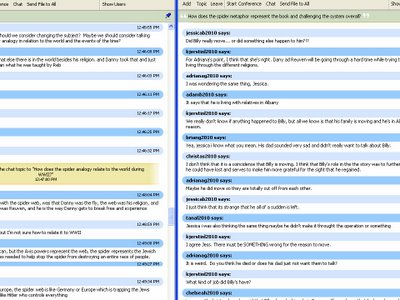
The students signed up for accounts through Skype and added me to their contact list. We made sure to communicate with the students the importance of not publishing any personal information over the Internet and encouraged them to use their Blogger display name along with an additional set of characters as their Skype username (both for safety and to create a unique username).After a few glitches, we were able to get everyone added and connected to one another. We completed some initial test runs with practice questions balancing two chat sessions occurring at the same time. We displayed the conversation side by side on their screens as well as projected onto the screen at the front of the classroom. At first it was truly mesmerizing to see how fast they were posting. However, it raised some interesting pedagogical questions regarding depth and quality of insight. My hope of using Skype versus Blogger was to use multiple online conversations with the outer circle in tandem with the inner circle conversations of the fishbowl. With Blogger, we created one post and the students commented on that. Even if we created multiple posts in Blogger, it would be difficult for students to follow multiple conversations due to the refresh issues.

When using Skype with the Fishbowl technique, I was looking for how it enhanced or detracted from the conversation. With Skype students noticed the conversation moved at a much faster pace allowing for them to comment more frequently, but at the same time, they put less thought into what they posted. Once again we, as a class, went back to the drawing board establishing Skype guidelines while reflecting on our Blogging guidelines. We had to focus on what it was we did well and liked about Blogger, but at the same time how could we make Skype better while increasing our learning and collaboration without sacrificing the quality of conversation.

It was really amazing to see them connect so easily to one another in the two smaller outside circle groups. I had split up the outer circle into the two smaller conversations so that the connections could be more instantaneous and lively. I also enjoyed hearing and seeing their connections between the conversations from the inner and outer circle as well as between the two Skype conversations. They did a much better job after reflection and analysis of referencing one another, using complete sentences, and expressing complex thoughts. In addition, since we are using an inquiry based approach to this entire semester focusing on the question of “what does it take to challenge the system?” I have been impressed to see how easily the students connect back to previous pieces of literature we have studied (Macbeth, Inherit the Wind, The Chosen, Fahrenheit 451) as well as referencing common themes and motifs they see reoccurring through each (appearance v reality, relationships between men and women-marriages, hands, eyes, challenging the system, price of progress, ambition, power).

Skype is still up for debate, but the students really seem to see the value in it as seen from their commenting to the posts regarding its trial run in class. Also, within the links below, please read through the transcripts of their conversations :

http://annesmith9h.blogspot.com/2006/11/chosen-fishbowl-1-3-period-2.html

http://annesmith9h.blogspot.com/2006/11/chosen-fishbowl-1-3-period-5.html

http://annesmith9h.blogspot.com/2006/11/reflecting-back.html

The Chosen Period 2 Fishbowl Group One

The Chosen Period 2 Fishbowl Group Two

The Chosen Period 5 Fishbowl Group One

The Chosen Period 5 Fishbowl Group Two


As for me, the verdict is still out on Skype. I am impressed by my students’ abilities with multi-tasking and the quality of conversation available to them through Skype. I agree that it is much faster paced allowing for their conversation to develop as fast as they want; but at the same time, I appreciate it more when they slow down and listen to one another. It was really important to have a conversation with them about the purpose behind Skype and more importantly, behind fishbowl. After we completed a few Blogger and in class reflections, now they are doing a more comprehensive job commenting and connecting with one another using Skype than they did with Blogger. I guess I just thought that I would not have to re-teach the things they did so well with Blogger. In my mind, it just took longer to get them to that “good” place than it had previously.

Regardless of either using Skype or Blogger, the growth in my students’ learning with the use of these technological pieces and fishbowl has been tremendous. They connect every piece of text we have studied this semester to each other as well as see connections with themselves as learners and with the world around them. They can produce interesting, captivating thoughts and are learning to value one another’s opinions and insights. They are learning and teaching one another! Isn’t that what education should be all about? Before Blogger and Skype, I was the only one who could witness their growth as learners because the fishbowl had to feed through me before my students had access to the technology. Now that they have the technology they are able to see each other’s thoughts and growth as teachers and learners. This is NOT education as usual.

Tuesday, November 28, 2006

Romancing Your Computer

While 12 of my Honors American Literature students were in Hawaii, I decided do to a little experiment with the somewhat grumpy students who were left behind. I gave them the following objective: Develop your own understanding of American Romantic poetry based on the resources in your book; select and incorporate at least one extension, such as Romantic art, Romantic music, British Romantic poetry, or your own, original Romantic poetry. Use Photostory to present your findings.

I showed them how to use Photostory, helped them individually with interpreting tough poems, and then just gave them time. The results were impressive, and discussing the poems in small groups with individual attention was much more effective and engaging than discussing the poems with the whole class.

When we shared the Photostories in class, students voted on the following categories: Most Deeply Analytical, Most Sublime, and Most Creative and Entertaining. The winners are worth taking a few minutes to enjoy if you have time:

Kelm/Prado
Wilcox/Hunt
Crellin
Parietti/Lueders
Pullara/Harden

Friday, November 03, 2006

Social Studies and Videos

I hesitated to talk here about video, being a history teacher and all. But Barb's post on te Fischbowl inspired me to share.

Many of my students will tell you (or complain to you)that I can take a 30 minute video and turn it into a 3 hour tour as I stop the video and have so many discussions. I ususally believe that these conversations are more important than the video and the video is simply a vehicle for the conversations. The weaknesses in my methods tend to be my inability to stay on track time-wise with the department's curricular goals and the fact that most of the conversations are based on MY questions or observations that I ask the students to respond to. Rarely do they create the questions or pose the observations that become the video conversations.

So...what did I try? In A.P. Government, I have shown a video for the last 6 years called "Why Can't We Live Together?", a Tom Brokaw special that examined the issue of race, white flight, perceptions and self-fulfilling prophesies in a middle/upper-middle class suburb of Chicago that tends to mirror our world in many ways. The conversations in class can often be uncomfortable for some as we speak publically about an issue that few find comfortable. This time, as we watched the video, I held back from stopping it (for the most part). Instead, they blogged as we watched. They shared their observations and questions. We responded primarily through the blog and I only stopped to have a discussion based on a question or comment they had posted.

What did I think of the experiment?

There were some positives. Students, for the most part, were not passive watchers, but active participants with EACH OTHER. A number of good conversations were held, much like those in the past. Some students shared great resources or anecdotes. We have a record of the conversation which is interesting to look back on to see how the conversations changed as they were presented with new information.

But, regardless of the positives, I'm not sure I like it. Some struggled with the multitasking. Much of what the video offered was missed or ignored. Instead, some students turned to a more generic discussion of race. While I like them having the conversation, the video offered some specifics that challenge or support many of the generic pieces. From many, those were missed. I watched a number of students only watch their laptop screen as they tried to keep up with comments.

Additionally, blogging is the wrong tool. Maybe something like skype would be better, but I had not yet created that capability in class. Blogging made the conversation very jumpy as responses to comment A are not seen until eight to ten other comments have been posted.

A few outsiders joined our conversation, one who threw gasoline on a fire. Because of the topic, I then had to be even more vigilant with each new post as I felt like I was no longer responsible just for what my students posted.

Will I try it again? Probably, but I will try a different tool, will discuss more the multitaking aspect and their responsibilty with the video info. But I suppose I should wait for them to respond before I decide.

Friday, October 27, 2006

Final Exams...Already?

We started looking at material for the final exam in Astronomy class. While this assessment has the possibility to look like many things I started to think about the course title and how that could be a part of the final. The students have been doing a great job creating their own information for this class and the assignments that they have been given. The course title is "Planetary Astronomy." When thinking about this and the final I became interested in what the students thought about the class. I have spent a lot of time during the past few years taking the students on what seemed to be a tour of the Solar System and have not given them the time to take their own tour. With the computers in the class, I think that they could gather enough information to design their own tour. The software is there (Photostory) and the internet (along with print sources) could provide ample information for the students.

If anyone has thoughts or ideas of how this could look please let me know. I think it will be a good project but there are some questions that I still have and some that I am sure I have not thought of. I really do not know how I would grade this projects (or do I let the students grade themselves?).

Wednesday, October 25, 2006

Fishbowl 101

When I was in college, I had some wonderful professors (Dawn Duncan and Jim Postema- Concordia College) who not only taught us how to think for ourselves, but also challenged us to teach one another. Recall the phrase, to teach is to learn. This might not seem like a big deal, but to ask sophomores and juniors in college to teach their classmates a novel per week complete with criticism as well as facilitating a conversation for an entire college class period was a daunting task. This is where the fishbowl began.

When I began teaching a senior level English class at Arapahoe, I became frustrated that I was to be the center of their learning. These kids have spent three years listening and watching their teachers teach; why couldn’t they be the expert on a piece of literature? However, I felt that they could not simply teach an entire piece of literature to one another in one week. So one day, I talked to the kids about how I learned in college and the difference it made in my learning to teach something rather than simply sitting back to listen to what my teacher told me to think about a novel. They were truly interested in the challenge of trying out fishbowl. They wanted their education to be different. I sat down and talked with our “new” instructional coach, Ray Hawthorne, and we talked through what changes would be necessary to make this work for high school. I decided that students would need to know how to ask good questions (higher level thinking questions), how to facilitate a conversation while still being able to get their point across, how to manage the classroom, how to look for criticism and understand the criticism they found, as well as actually understand what they read.

After much refinement, discussion, trial and error, and more trial and error as well as feedback from that first group of seniors ( the feedback is essential every year to tweak it to what best benefits the students), the fishbowl emerged.

There have been times it has not worked with a particular group of kids. There have been times it has simply blown my mind to see what they have come up with. [Please make sure to reference the handout as you read this section to understand the layout of the fishbowl] In the beginning, the outer circle merely reacted to the conversation in a journal format (only I would see these reactions). However, now we have many variations to the outer circle. We have also had the students T-note the questions from the inner circle and reacted to these. Other times students used a discussion tracking method keeping track of who said what and the reaction from those statements. Now my classes are live blogging on the outside so that there are actually two separate conversations occurring. Sometimes these conversations intertwine and sometimes they go in two separate directions. Either way, the best part of it is that the students are reacting to one another. I become a participant in their conversation rather than the director. That being said, sometimes I need to be a facilitator. I participate in the conversation with my freshman and sophomores, where with my seniors I stay out of the conversation and become an observer. (Actually this was a request from my first group of seniors who noted that every time I tapped into the conversation, the kids would take what I say as gospel. They thought it best to keep me out and they would grant me the last ten minutes of class to say what I think-they were so generous! I usually negotiate this piece on a class by class basis asking how much they want me to be involved).

How do the kids prepare? There are a few ways: one, the kids decide their own groups and can choose from a set of predetermined dates to present on. By allowing the students to create their own groups, they have more control, autonomy, and decision making ability than with pre-assigned groupings. Two, the kids read their assigned section, meet and discuss on what will be the focus of the conversation. They compose a syllabus for the class discussion which they turn in ahead of time to me for feedback. They must also find criticism to extend, support, or challenge our thinking on their assigned chapters. The criticisms often allow for the students to create great blogging questions for the class to react to after our fishbowls. The classes are often very good at making sure topics from previous discussion are referenced but they tend to hold each other accountable when one topic becomes too repetitive. My freshmen come with their own individual questions - they do not meet as a group ahead of time. They each create three higher-level questions which we post on the blog, write on the chalkboard or change the discussion direction.

As previously stated, teaching the kids good questioning strategies, methods for facilitating a discussion, and frequently asking for their feedback about how it went and what suggestions they have for improvement is so important.

Brains come alive

I borrowed an adapted assignment from my good buddy Kristin called Fun with Brains regarding the characters from Fahrenheit 451. Students were to select four characters and dissect each brain into four quadrants equal to the amount of the brain devoted to a particular subject that character would be thinkng about. After completing that portion of the assignment, they were to attribute quotes and explanations to these sections. Here are some samples to share using different tools of technology.

Period Two:
Adrianna
Alee
Emily
Jessica

Period Five:
Ben
Emily L.

Sunday, October 15, 2006

Conferences coming up

With the imminent approach of parent teacher conferences, I am interested in some reflections from my students over the past 9 weeks (this means we are halfway through the semester-yahoo). What do you think? Has class meet your expectations? What is challenging you? What is exciting you about class? Also, I would encourage you to reflect back over the projects we have accomplished this semester and evaluate those as well. Take a look at what other classes have done:
English Nine podcasts:
www.smithenglish9.blogspot.com
This I Believe podcasts
English Nine Honors SAT vocab assignment:
www.annesmith9h.blogspot.com
Wonder Woman Gone Country
English Literature scribe:
www.smithewl.blogspot.com
Daily Scribing

Also, think of this, I will be sitting in the gym for three and one half hours each night for two nights over the parent teacher conference time, what do you want your parents to know?

Tuesday, October 10, 2006

Mr. Meyer...when will we really start using them?

I have waited to post here as I have felt that, in comparison to other laptop rooms, we have done little so far. We have blogged (sometimes to an obsessive extent), but that has been done out of class. We did some research in class, utilizing our laptops to look at the constitutionality of some scenarios and then finding cases to support our findings. The activity seemed to play out much like it had without computers, except the computers seemd to slow them down a bit. The two times they were the most helpful were when the counselors took the seniors and when we had a sub. Both times, I was able to create lessons that I think had value rather than relying on a video (usually used just in case the sub wasn't prepared for A.P. level discussions).

So what have we been doing? In my mind, we have spent six weeks developing a constructivist mindset where students have created an atmosphere where they want to know more, where they are challenging each other to support their ideas, where they are participating beyond "is it on the test?" discussions. Now they are ready for laptops and the wikis, podcasts, etc. that are better suited to future units.

Wednesday, October 04, 2006

Finding the Right Balance

With the exception of my first hour English 10 class, I teach in a "laptop classroom" where the laptops are not used on a daily basis. In my 4th and 6th hour Honors American Literature classes, for example, the laptops are rarely used for the entire period, and we probably take them out of the cart about two or three days out of the week. I deliberate over how to incorporate the laptops in my planning. While I realize that the laptops hold endless potential, I tend to abstain from designing units and lessons that revolve around the technology. To be honest, I alternate on a daily basis between feeling guilty for not using the laptops enough and feeling guilty for too often sacrificing valuable non-laptop activities for the ones that utilize the technology (and may or may not be a success).

I would like to hear from the students' perpsectives where this balance lies. Students in the laptop classrooms--what impressions have the first six weeks left on you? In other words, which activities have the laptops genuinely enhanced, and which have they detracted from? Have we, your teachers, found a productive balance? --Ms. Kakos

Monday, October 02, 2006

Astronomy and Computers

The past few yars, in an astronomy elective that I have taught, I have presented material on all of the different types of telescopes that are used by astronomers. With the addition of the computers to the classroom, I have been trying to figure out new ways to utilize them and still cover the material that needs to be covered. (I am actually tring to decide what this material is also.) I decided to give all the information (A PowerPoint, a research document and a student designed document) all at once and then to allow the students to choose the time and course of study. The end result needs to be a document (not just a typed one) that could be used to explain a type of telescope and attempt to market it. However, this would allow the students who already know some about telescopes to skip the basics and get into the "fun" assignment. I am going to start this adventure tomorrow and cannot wait to see how it goes.

If you are interested in some of the work that my class has put together up to this point please check out their wiki at [www.ahsastronomy.pbwiki.com]

I think that we will attempt to create a photo story for a tour of the Solar System. I am not sure what this will look like but that is up next. I am also trying to determine how to get all of this information into a portfolio so if there are any ideas out there please let us know.

An urgent message from Will

The following comment appeared under my post "potpourri." I thought you could all help out Will...

TIME OUT! TIME OUT! TIME OUT! TIME OUT! TIME OUT! TIME OUT!

Hope I got your attention, this is very IMPORTANT.

I have an URGENT message. Today in AP Gov, Meyer brought up a very interesting bill called the DELETING ONLINE PREDATORS BILL, despite the nice title, the bill will destroy what we and the Arapahoe High School staff have attempted to create. Please research this bill. The gist of the bill is that all access to chat rooms, BLOGS, myspace,and perhaps even simpler pages that might allow students to display any kind of personal information will be denied to students.

This bill will be extremely detrimental to the education, will destroy everything we have worked hard to establish, and eliminate the benefits to internet in the classroom that many of you enjoy. THIS BILL PASSED IN THE HOUSE OF REPRESENTATIVES BY A VOTE OF 410-15. Our time window is incredibly short to take any kind of action against this bill before it is passed by the Senate and it WILL be passed. We must take action now, IF THERE IS A WAY TO ORGANIZE A MEETING FOR CONCERNED STUDENTS I WOULD BE GRACIOUS FOR INFORMATION ON HOW TO GET A ROOM AND ANNOUNCEMENTS.

Any strategies on how not to get this bill passed would be greatly appreciated, I have a few, but I would prefer one in which I don't have to be suspended or expelled :).

Sunday, October 01, 2006

Potpourri

I do have to say things have been interesting in the Wonderful World of Constructivism (roll sound byte). Listening to the podcasts of my regular ninth graders' "This I Believe" essays has changed my view on some of their written pieces. It really speaks of how difficult it is to teach voice in writing, when hearing their actual voice of their essays comes through so easily. Some still need more polishing as well as them learning to plan ahead.

I guess that is a frustration I am feeling now. Here is this really interesting assignment, something they created, and then so many wait till the last moment to go out and complete it, rushing through it as though they do not really care that it is their best work. So it makes me wonder, why do another cool, challenging reflective assignment? Am I going to get the same results? The same lackadaisical last minute work ethic? Why challenge them to be better when they could care less themselves? I am trying to be better and challenge myself to break out of the assembly line production of kids to help them realize their true potential, but I feel right now that I am busting my derrière for nothing. Pardon my French (for those of you that kow me this is my kind of humor). I am frustrated! Do they see how good they can be? DO they see the moments of brillance I see? Am I not getting them? Is there something I am missing? I think I am going through a Karl moment-the glass is feeling close to half empty.

On the brighter side, I encourage you to listen to their podcasts on their English Nine class blog and give them constructive feedback. It was unbelievable that after the first day it was up, they already had a messsage from New Zealand (go Kiwi).

Additionally on an even brighter side, I do have to say that I am not giving up hope. I am starting Digital Storytelling with my regular ninth graders this week. Throughout this entire semester we are examining this idea of "What Matters" and realting each piece of literatture back to ourselves as well as the world around us. Everything connects to "What Matters." You can check out the full assignment on the AHS homepage-teacher web pages-Mrs. Smith-English 9-What matters. I would love to know what you think.

Thanks for listening.